When ordering fractions there are two main ways to do this
1) Convert each fraction to a decimal and then order
or
2) Write each fraction over a common denominator.
Example of method 2)
Saturday, 6 September 2014


Sunday, 6 April 2014
Angles and Angle Theorems
Different sized angles have different names. These are illustrated below


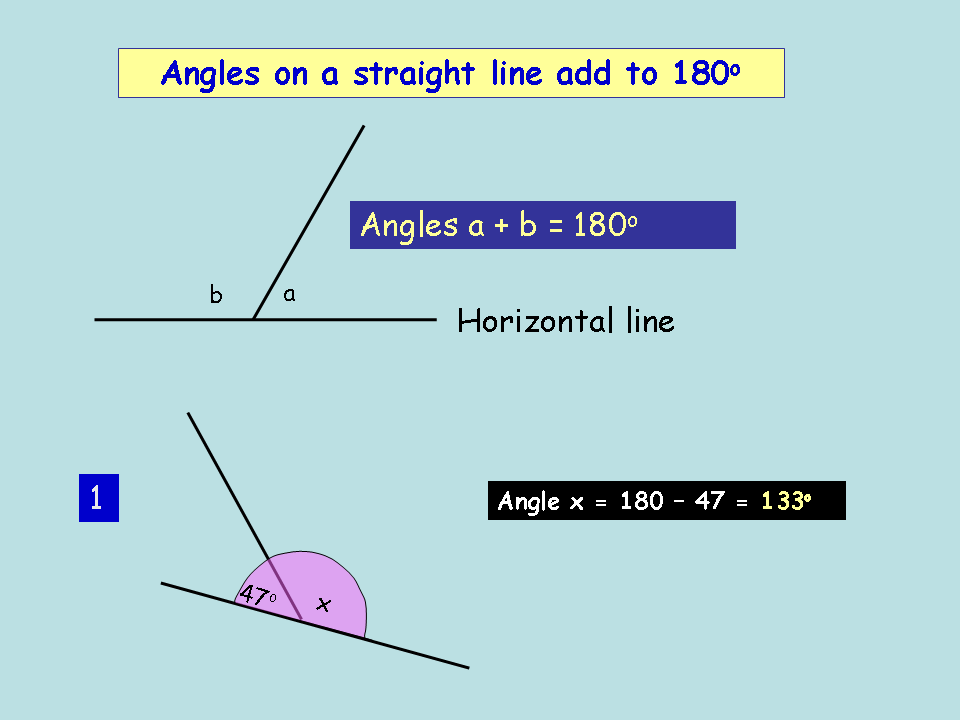 Angles at a point add up to 360 degrees
 Angles in a triangle equal 180 degrees

Angles in parallel lines

There are many different angle theorems some are listed below:
Adjacent angles on a line add up to 180 degrees
Thursday, 20 March 2014
Solving Equations
To solve equations we use inverses (do the opposite) to find out what the unknown is
One step equations
Examples:
1) 2x = 8 We divide both sides by 2 to get x on its own
x = 4
2) x + 5 = 9 We subtract 5 from both sides
x = 4
3) x - 2 = 12 We add 2 to both sides
x = 14
Two step equations
Examples:
1) 2x + 1 = 5 First we subtract 1 to get 2x on its own
2x = 4 Then we divide both sides by 2 to get x
x = 2
2) 3x - 5 = 16 Add 5 to both sides
3x = 21 Divide both sides by 3
x = 7
3) 7 - 4x = 3 Because we have a minus 4x we add this first
7 = 3 + 4x Now subtract 3
4 = 4x Divide both sides by 4
x = 1
Unknowns on both sides
Examples
1) 2x + 3 = x + 5 Deal with the smallest x in this case x on the RHS
x + 3 = 5 Now continue as above
x = 2
2) 3x - 7 = 5x + 9 Be careful with negatives
-7 = 2x + 9
-16 = 2x
- 8 = x
Equations with Brackets
First multiply out the brackets then continue as above
Examples
1) 3(2x + 5) = 33
6x + 15 = 33
6x = 18
x = 3
2) 2(x + 7) = 3(2x - 2)
2x + 14 = 6x - 6
14 = 4x - 6
20 = 4x
5 = x
One step equations
Examples:
1) 2x = 8 We divide both sides by 2 to get x on its own
x = 4
2) x + 5 = 9 We subtract 5 from both sides
x = 4
3) x - 2 = 12 We add 2 to both sides
x = 14
Two step equations
Examples:
1) 2x + 1 = 5 First we subtract 1 to get 2x on its own
2x = 4 Then we divide both sides by 2 to get x
x = 2
2) 3x - 5 = 16 Add 5 to both sides
3x = 21 Divide both sides by 3
x = 7
3) 7 - 4x = 3 Because we have a minus 4x we add this first
7 = 3 + 4x Now subtract 3
4 = 4x Divide both sides by 4
x = 1
Unknowns on both sides
Examples
1) 2x + 3 = x + 5 Deal with the smallest x in this case x on the RHS
x + 3 = 5 Now continue as above
x = 2
2) 3x - 7 = 5x + 9 Be careful with negatives
-7 = 2x + 9
-16 = 2x
- 8 = x
Equations with Brackets
First multiply out the brackets then continue as above
Examples
1) 3(2x + 5) = 33
6x + 15 = 33
6x = 18
x = 3
2) 2(x + 7) = 3(2x - 2)
2x + 14 = 6x - 6
14 = 4x - 6
20 = 4x
5 = x
Saturday, 15 March 2014
Probability
Probability all is all about the chance of something happening.
Probability Words
If a question asks you to describe the probability using words the words most often used are
Impossible - Absolutely no chance it will happen
Unlikely - there is a small chance it will happen
Even Chance - the probability is a half or 50 - 50
Likely - it is not definitely going to happen but there is a good chance
Certain - it will definitely happen.
These words can be displayed, with numbers along the probability scale.
Probability Calculations
Probability of something happening
If the question asks you to calculate the probability the answer will need to be given as a numerical answer usually a fraction but sometimes written as a decimal or percentage.
To calculate the probability of something happening we use the following formula

Example: The probability of getting a 5 when rolling an ordinary dice is 1/6 because there is 1 number 5 on the dice out of 6 possible different answers.
The probability if getting an Ace from a standard pack of cards is 4/52 because there are 4 aces and 52 cards this can be simplified to 1/13. You could also say that it is 1/13 because there are 13 cards in a suit and 1 of them is an ace.
Probability it doesn't happen
The probability of something not happening is 1 - the probability it does. This is because either that thing is going to happen or it will not happen and so it covers all possibilities and together they equal 1.
Example: The probability it will rain tomorrow is 0.56 so the probability it won't rain is 1 - 0.56 = 0.44
Experimental Probability and Relative Frequency
Probability can be used to predict results or to see if something is fair. For example if I flip a coin 10 times theoretically we should get 5 heads and 5 tails but in reality we may get 7 heads and 3 tails. From 10 results this may not seem odd, but if we flipped a coin 1000 times and got 700 heads and 300 tails you may think the coin is biased.
Relative frequency is the probability that an experiment produces. For example above where I flipped my coin 10 times the theoretical probability of a head is 0.5 but in the experiment I got a head 7 out of 10 times so the relative frequency or experimental probability is 0.7.
Probability Words
If a question asks you to describe the probability using words the words most often used are
Impossible - Absolutely no chance it will happen
Unlikely - there is a small chance it will happen
Even Chance - the probability is a half or 50 - 50
Likely - it is not definitely going to happen but there is a good chance
Certain - it will definitely happen.
These words can be displayed, with numbers along the probability scale.
 |
| The Probability Scale |
Probability Calculations
Probability of something happening
If the question asks you to calculate the probability the answer will need to be given as a numerical answer usually a fraction but sometimes written as a decimal or percentage.
To calculate the probability of something happening we use the following formula
Example: The probability of getting a 5 when rolling an ordinary dice is 1/6 because there is 1 number 5 on the dice out of 6 possible different answers.
The probability if getting an Ace from a standard pack of cards is 4/52 because there are 4 aces and 52 cards this can be simplified to 1/13. You could also say that it is 1/13 because there are 13 cards in a suit and 1 of them is an ace.
Probability it doesn't happen
The probability of something not happening is 1 - the probability it does. This is because either that thing is going to happen or it will not happen and so it covers all possibilities and together they equal 1.
Example: The probability it will rain tomorrow is 0.56 so the probability it won't rain is 1 - 0.56 = 0.44
Experimental Probability and Relative Frequency
Probability can be used to predict results or to see if something is fair. For example if I flip a coin 10 times theoretically we should get 5 heads and 5 tails but in reality we may get 7 heads and 3 tails. From 10 results this may not seem odd, but if we flipped a coin 1000 times and got 700 heads and 300 tails you may think the coin is biased.
Relative frequency is the probability that an experiment produces. For example above where I flipped my coin 10 times the theoretical probability of a head is 0.5 but in the experiment I got a head 7 out of 10 times so the relative frequency or experimental probability is 0.7.
Thursday, 6 March 2014
Transformations
Rotation:
When performing a rotation we need 3 pieces of information:
A centre of rotation (either given as a point or sometimes described as the origin which is the point (0,0))
A direction - either clockwise or anti clockwise (Unless the angle is 180 degrees where it doesn't matter)
An angle.
To perform a rotation use tracing paper and trace your shape, place your pencil on the centre of rotation and rotate the given angle in the given direction to see where the shape is rotated to.
Reflection:
When performing a reflection we need to know which line is the mirror line. This will either be given on the question or expressed as an equation of a line.
Remember x = 2 is a vertical line which passes through the x axis at the point 2 and y = 3 would be a horizontal line which passes through the y axis at the point 3.
A reflection should look like a mirror image and a mirror can be used if you need extra help.
Translation:
A translation is where an object is moved (without reflecting, rotating or enlarging). Usually the translation will be described by a vector, where the top number represents the x direction and the bottom number the y direction.
Enlargement:
There are two types of enlargement, one without a centre and one with.
A basic enlargement requires you to enlarge a shape by a given scale factor but it doesn't matter where the shape is drawn. If a shape is enlarged by scale factor 3, each side of the original shape needs to be multiplied by 3 to give the enlargement.
An enlargement from a given centre requires you to draw an enlargement the centre also specifies where the shape should be drawn.
See the example below:
.png) Sometimes an enlargement can make a shape smaller, but this is still called an enlargement, this happens when the scale factor is between 0 and 1.
Sometimes an enlargement can make a shape smaller, but this is still called an enlargement, this happens when the scale factor is between 0 and 1.
Describing a transformation
When you describe a transformation you need to look at what has happened to the original shape. Has it been turned (it's a rotation), flipped (a reflection), made bigger or smaller (an enlargement) or simply just moved (a translation). You will also need to describe how so if it's a rotation remember the 3 bits of information needed 1) Centre 2) Direction 3) Angle. If it is a reflection write down the mirror line as an equation. If it is an enlargement write down the centre and the scale factor and if it's a translation write down the vector by which it has been translated.
When performing a rotation we need 3 pieces of information:
A centre of rotation (either given as a point or sometimes described as the origin which is the point (0,0))
A direction - either clockwise or anti clockwise (Unless the angle is 180 degrees where it doesn't matter)
An angle.
To perform a rotation use tracing paper and trace your shape, place your pencil on the centre of rotation and rotate the given angle in the given direction to see where the shape is rotated to.
Reflection:
When performing a reflection we need to know which line is the mirror line. This will either be given on the question or expressed as an equation of a line.
Remember x = 2 is a vertical line which passes through the x axis at the point 2 and y = 3 would be a horizontal line which passes through the y axis at the point 3.
A reflection should look like a mirror image and a mirror can be used if you need extra help.
Translation:
A translation is where an object is moved (without reflecting, rotating or enlarging). Usually the translation will be described by a vector, where the top number represents the x direction and the bottom number the y direction.
Enlargement:
There are two types of enlargement, one without a centre and one with.
A basic enlargement requires you to enlarge a shape by a given scale factor but it doesn't matter where the shape is drawn. If a shape is enlarged by scale factor 3, each side of the original shape needs to be multiplied by 3 to give the enlargement.
An enlargement from a given centre requires you to draw an enlargement the centre also specifies where the shape should be drawn.
See the example below:
Describing a transformation
When you describe a transformation you need to look at what has happened to the original shape. Has it been turned (it's a rotation), flipped (a reflection), made bigger or smaller (an enlargement) or simply just moved (a translation). You will also need to describe how so if it's a rotation remember the 3 bits of information needed 1) Centre 2) Direction 3) Angle. If it is a reflection write down the mirror line as an equation. If it is an enlargement write down the centre and the scale factor and if it's a translation write down the vector by which it has been translated.
Sunday, 2 March 2014
Drawing Quadratic Graphs
A quadratic graph will always be a u or n shape depending on whether it is positive or negative.
Always draw your graphs using a pencil and they should be a smooth curve going through all your plotted points
To draw a quadratic graph you will be given an equation and you will need to use x values to create y values to enable you to draw your graphs.
See the example below
.png)
Always draw your graphs using a pencil and they should be a smooth curve going through all your plotted points
To draw a quadratic graph you will be given an equation and you will need to use x values to create y values to enable you to draw your graphs.
See the example below
Sunday, 2 February 2014
Ratio and Direct Proportion
Ratio is all about sharing and being fair.
We can simplify ratios in a similar way to fractions. If we divide all parts by the same amount we are keeping the ratio equivalent.
Examples:
1) 10:20 divide both sides by 10 we get 1:2 this is simplified.
2) 27:36 divide both sides by 9 we get 3:4
3) 24:64:16 divide all parts by 8 we get 3:8:2
We can also divide in a ratio
Examples:
1) Share £200 between Anna and Bob in the ratio 1:3
There are 4 parts all together (1 + 3 = 4) so divide the original amount by the number of parts £200 divide 4 = £50 so Anna gets 1 part = £50 and Bob gets 3 x £50 = £150 their amounts add up to the starting amount.
2) Share £1000 between Carl, Dave and Emma in the ratio 2:3:5
2 + 3 + 5 = 10
£1000 divide 10 = £100
Carl gets 2 x £100 = £200
Dave gets 3 x £100 = £300
Emma gets 5 x £100 = £500.
Direct Proportion
Lots of questions involving direct proportion are either about ingredients or the cost of items.
Examples:
1) This is a list of ingredients needed to make 24 scones
600g flour
100g dried fruit
250g butter
Water to mix
a) How much dried fruit is needed for 6 scones?
1st see how the number of scones the ingredients are for relates to the amount in the question.
6 scones is a quarter of the original 24 so we divide the amount of dried fruit in the original list of ingredients.
100g divide 4 = 25g of dried fruit to make 6 scones
We can simplify ratios in a similar way to fractions. If we divide all parts by the same amount we are keeping the ratio equivalent.
Examples:
1) 10:20 divide both sides by 10 we get 1:2 this is simplified.
2) 27:36 divide both sides by 9 we get 3:4
3) 24:64:16 divide all parts by 8 we get 3:8:2
We can also divide in a ratio
Examples:
1) Share £200 between Anna and Bob in the ratio 1:3
There are 4 parts all together (1 + 3 = 4) so divide the original amount by the number of parts £200 divide 4 = £50 so Anna gets 1 part = £50 and Bob gets 3 x £50 = £150 their amounts add up to the starting amount.
2) Share £1000 between Carl, Dave and Emma in the ratio 2:3:5
2 + 3 + 5 = 10
£1000 divide 10 = £100
Carl gets 2 x £100 = £200
Dave gets 3 x £100 = £300
Emma gets 5 x £100 = £500.
Direct Proportion
Lots of questions involving direct proportion are either about ingredients or the cost of items.
Examples:
1) This is a list of ingredients needed to make 24 scones
600g flour
100g dried fruit
250g butter
Water to mix
a) How much dried fruit is needed for 6 scones?
1st see how the number of scones the ingredients are for relates to the amount in the question.
6 scones is a quarter of the original 24 so we divide the amount of dried fruit in the original list of ingredients.
100g divide 4 = 25g of dried fruit to make 6 scones
b) How much flour would you need for 36 scones?
36 scones is 1.5 times as many as the list of ingredients so multiply the amount of flour by 1.5 (or add half as much on again)
600g x 1.5 = 900g of flour needed to make 36 scones
Subscribe to:
Posts (Atom)